

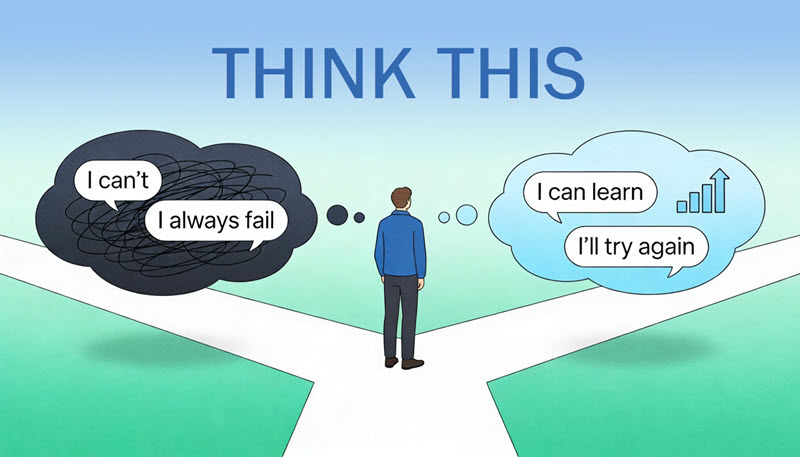
“Think This, Not That” is about choosing better thoughts on purpose so your actions and identity slowly change to match. Anyone can learn it with practice.
1. The core idea: Thoughts → Feelings → Actions → Results
Your thoughts create your feelings, your feelings drive your actions, and your actions create your results.
So the quickest lever you control is the thought you choose in any moment.
- Old chain: “This is too hard” → frustrated → procrastinate → stay stuck.
- New chain: “This is hard, and I can learn it” → focused → take one step → make progress.
Mindset shift: You don’t have to believe your first thought. You can notice it, question it, and pick a better one.
A simple rule:
- Notice: “What am I thinking right now?”
- and Name it: “That’s a ‘give‑up’ thought.”
- THEN Swap it: “What’s a truer, more useful thought I can think instead?”
2. Self‑awareness: Catch the thought before it runs you
You can’t change the thought you don’t see. Self‑awareness is the skill of noticing what’s happening inside you in real time.
A. Daily 2‑minute “thought log.”
Once a day, write 3 lines:
-
-
- Situation (facts only): “Boss moved the deadline up.”
- Thought: “I’ll never get this done.”
- Feeling + action: “Overwhelmed → scroll my phone.”
-
Do this for a week, and you’ll start to see your patterns: where you shrink, where you get angry, where you give up.
B. The 10‑second pause
Build a habit:
-
-
- When you feel triggered (tight chest, clenched jaw, racing mind), silently say: “Pause.”
- Take 3 slow breaths: in for 4, hold for 2, out for 6.
- Ask: “What am I telling myself right now?”
-
That question alone pulls you out of autopilot and into awareness.
C. Name your “greatest hits” thoughts
Most people recycle the same handful of limiting thoughts:
-
-
- “I’m not good enough.”
- “This never works for me.”
- “People like me don’t succeed at this.”
- “If I can’t do it perfectly, why bother?”
-
Write your top 3 on paper. Now you can recognize them when they show up, like “Oh, there’s that old ‘I’m not good enough’ story again.”
3. Emotional regulation: Feel it without being ruled by it
“Think This, Not That” is not “never feel bad.” It’s “I can feel anything and still choose my next move.”
A. The 4‑step “Feel, Don’t Fuel” method
When a strong emotion hits:
-
-
- Notice: “I’m feeling anxious/angry/ashamed.”
- Locate: “Where is it in my body?” (tight throat, burning chest, heavy stomach).
- Breathe: Slow, deliberate breaths into that area for 60–90 seconds.
- Label gently: “This is anxiety, and it’s allowed to be here.”
-
You’re not suppressing or dramatizing the emotion—you’re letting it move through without turning it into a story.
B. Separate facts from stories
Emotion spikes when we mix facts with scary stories.
-
-
- Fact: “They didn’t text back today.”
- Story: “They don’t care about me.”
-
Ask yourself:
-
-
- “What are the raw facts?”
- “What story am I adding?”
- “Is there another story that’s just as possible—and kinder?”
-
Practicing this makes your emotions more proportional to what’s actually happening.
C. Have a “calm kit.”
Build a simple menu of healthy ways to self‑soothe when emotions are big:
-
-
- 5 minutes of walking
- 10 pushups
- 5‑minute breathing app or timer
- 1 song you love, listened to with full attention
- 1 person you can text: “Rough moment, just venting.”
-
When you’re overwhelmed, pick one item and do it before you decide what to think or do next.
4. Growth‑mindset: Talk to yourself like a coach, not a critic
A growth‑mindset says: “Abilities grow with effort, feedback, and time.” Fixed mindset says: “If I’m not good now, I’ll never be.”
A. Turn “identity” statements into “process” statements
Instead of:
-
- “I’m bad with money.”
- “I’m not disciplined.”
- “I always quit.”
Try:
-
- “I haven’t learned good money skills yet, but I’m willing to.”
- “Discipline is a skill I’m building, one small promise at a time.”
- “In the past, I quit; this time, I’m learning to stay with it.”
You’re not lying; you’re describing yourself as a work in progress.
B. Reframe failure as data
When something goes wrong, ask three questions:
-
- “What worked at least a little?”
- “What didn’t work?”
- “What will I try differently next time?”
Then complete this sentence: “This didn’t work YET, and here’s what I’m going to adjust…”
Growth mindset people fail more often, not because they’re worse, but because they keep trying and tweaking.
C. Praise for effort, not just outcome
At the end of the day, write down:
-
- One thing you did (effort): “I made two prospecting calls.”
- One thing you learned: “My energy drops after lunch; mornings work better for outreach.”
- One thing you’ll try next: “I’ll schedule calls 9–11 am tomorrow.”
You’re teaching your brain to value progress over perfection.
5. “Think This, Not That” library: Swappable thoughts
Use these as templates and adapt the words to sound like you.
When you feel overwhelmed
-
- Not that: “There’s too much; I can’t handle this.”
- Think this: “There’s a lot, and I can handle the next step.”
Action: List the next micro‑step that takes 5–10 minutes and do only that.
When you feel behind
-
- Not that: “I’m so far behind; what’s the point?”
- Think this: “I’m behind, and starting now is better than not at all.”
Action: Set a 15‑minute timer and start; finishing is optional, starting is required.
When you feel not good enough
-
- Not that: “I’m not cut out for this.”
- Think this: “Nobody is ‘cut out’ at the beginning. I’m learning on purpose.”
Action: Ask, “What’s one small skill I can practice today?”
When you feel afraid of others’ opinions
-
- Not that: “If I fail, everyone will judge me.”
- Think this: “People are busy with their own lives; this is my experiment to run.”
Action: Do a tiny “courage rep” anyway—send the email, post the thing, make the ask.
When you’re tempted to give up
-
- Not that: “This will never work.”
- Think this: “This version didn’t work; there is a version that can.”
Action: Change one variable (time of day, message, audience, method) and try again.
6. Turn it into a daily practice (simple “how‑to” plan)
Here’s a practical 10–15-minute routine to build this mindset over 30 days.
Morning: Set your “Think This” intention (3 minutes)
Write:
-
- One situation you expect today that might be hard.
- The “Not That” thought that usually shows up.
- The “Think This” thought you’ll choose instead.
Example:
-
- Situation: “Afternoon sales calls.”
- Not that: “They don’t want to hear from me.”
- Think this: “Some will say no, and some need exactly what I’m offering.”
During the day: Use the pause (30–60 seconds each time)
Whenever you feel triggered:
-
- Pause and breathe.
- Ask: “What am I thinking?”
- Ask: “Is this helping me?”If not, swap it: “What’s a kinder, more useful thought?”
You won’t catch them all. Catch one today, maybe two tomorrow—that’s progress.
Evening: 5‑minute reflection
Journal three prompts:
-
- “Where did I think differently today?”
- “Where did I get hooked by old thoughts?”
- “What’s one ‘Think This, Not That’ I want ready for tomorrow?”
You’re teaching your brain a new language—one page at a time.
7. A mindset you can borrow today
If you remember nothing else, use this sentence for the next week:
“I am a person who can learn, adjust, and try again.”
Say it when things go well. Say it when they don’t. Say it when you want to hide.
That sentence alone is the heart of “Think This, Not That” and the engine of self‑awareness, emotional regulation, and a growth‑mindset.
Start small.
One thought, one breath, one action at a time.
